By Chad Pen Lowe, bostonese.com columnist
“You need the 入藏函(Letter to Enter Tibet)”, the tour bureau representative told me, after examining my USA passport. I couldn’t believe it. I was on my way to Tibet and was stopping by in Zhengzhou, a city in central China. “Could you double-check?”, I asked earnestly, hoping it was a mis-information on her part. “Before the train enters Tibet, there will be a checkpoint. Everybody who does not have a National ID card(身份证)or Letter to Enter Tibet will be turned back and sent onto the next train that comes back.”

Tibet was not on the agenda of my China trip. The main reason of the China trip this year was for my Mom’s major birthday in Hangzhou. I did not make it home to my Mom’s 70th birthday. Now 10 years later, I cannot miss this occasion. The idea of visiting Tibet only came to me when I passed by some travel books at the bookstore on Jie Fang Road in Hangzhou. I had also missed the 20th anniversary reunion of our high school classmates in Zhengzhou, so this time, with wife and kids still in California, I could also visit Zhengzhou, which is between Hangzhou on the east coast and Tibet on the far west of China. Although the speed of China’s railway has increased significantly, it still takes a full 48 hours from Shanghai to Lhasa, as compared to 12 hours of flight from Shanghai to Los Angeles. Tibet is home to Mount Everest, the highest mountain of the earth, with a height of 8848 meters. Since it’s on a high plateau, I thought taking a train would help alleviate the effect of high altitude, and I would not need to carry a mini-oxygen tank around.
| "Let me talk with your associate in Tibet directly", I demanded. The travel bureau has an associate stationed in Lhasa, the capital of Tibet. However over the phone, the associate told me basically the same story. He added, "ever since the incident where the Tibetan monks set themselves on fire, there has been stricter control for foreigners entering Tibet. It takes about a week to get approved for the Letter to Enter Tibet. And you're leaving tomorrow... Also you won't be able to enter Potala Palace (布达拉宫). You need advance reservation to get an admission ticket. That takes a day or two. If you're a Tibetan, you don't need a ticket to enter the palace. Since you have a USA passport, you may not be able to visit the palace without the National ID. Since you don't have the Letter to Enter Tibet, hotels won't be able to check you in." |
| The carriage, or car in American English, I was in was a hard-sleeper, with about 10 compartments. There are no doors between each compartment. There are a total of 6 beds in a compartment. Two girls in the compartment were heading to Xi Ning. One of them, I thought was a girl when she was lying in bed. Later when I went to the end of the carriage, she was smoking a cigarette there. Looking at the way she dressed, and her short hair, I quickly averted my eyes, 'damn, this is a lad'. But when we started talking, she sounded like a lady. She works near Hangzhou and was going back home to visit her family. |
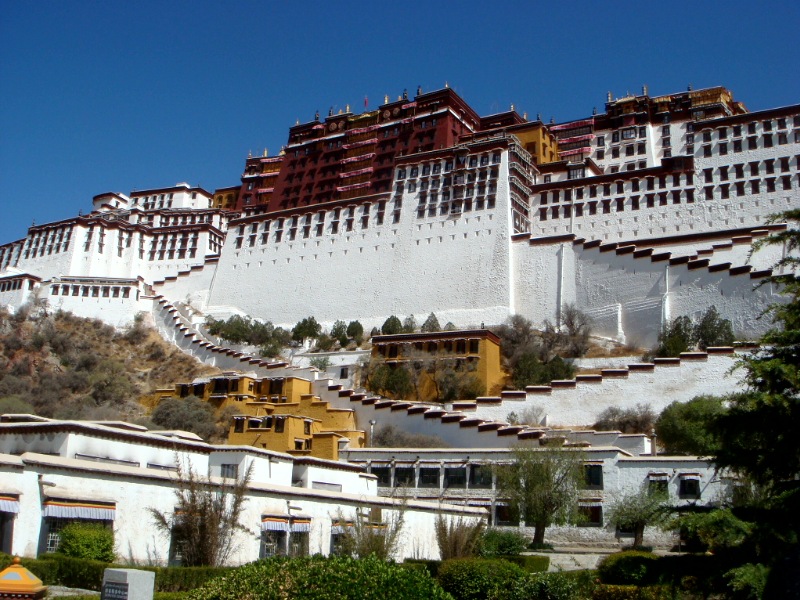 Potala Palace [/caption]
As train enters Tibet, we started seeing houses with distinctive Zang decorations on the roof top. They are colorful, in red, yellow, and other bright colors. It's very unique, and I knew I was in Tibet. Before the train arrived in Lhasa, a team of a man and a woman from the Tibet Tourist Bureau went across the carriages and advertised tours and hotels. "You can stay in this 3-star hotel, that is in the backyard of the Potala Palace. If you cough, the people in the Potala Palace will hear it. It's only 150 yuan. And our shuttle will take you directly from the train station to the hotel." Considering that during the May 1st holiday, the hotels in Hangzhou were fully booked and costed 350 yuan, this Lhasa hotel sounded like a good deal. I called my classmate's contact in Lhasa. He told me it's very difficult to book a hotel in Lhasa for foreigners without the Letter to Enter Tibet. Basically he had no way. So I asked him to come to the train station to pick me up and then take me to the hotel, to see if there will be any issues that he could help.
7:30pm in the evening, the train pulled in to Lhasa station. It was quite cold, but still bright. "Your National ID card please. We're not checking train tickets, only the ID cards." Armed policemen spoke to the train riders crammed at the exit gate of the train station. There were over a dozen policemen (特警) in uniforms. I handed the policeman my USA passport. "What country's passport is this?", he asked. "USA". At first, he told me to wait, and went to check with his supervisor. After a big while, he came back. "You need to register here", he told me politely. He copied down my passport number and other information. There were some other tourists at the registration desk, some of them did not have the national ID cards, and some of them were from Hong Kong. There were no foreigners coming out of the train.
After registering me, the special agent went back and checked with his supervisor again. When he came back again, he told me to follow another policeman to the police station (派出所), along with three other people. "What's happening? Why so much scrutiny?" I asked the policeman. "There has recently been a situation", he replied. When I asked what kind of situation, he said he could not tell me.
After getting to the police station, they took my passport and went to make a copy. The other three people are Tibetans. It looked like they did not have the IDs. "Where are you staying in Lhasa?", a head policeman at the station asked me. "Well, there is this travel agent on the train that is going to put me into a hotel at the back of the Potala Palace." "Which hotel", he insisted. "I can't remember. Let me find his business card... Here it is. He knows the name of the hotel." "Call him." "Ok, can I use your phone?" "Fine".
Luckily the travel agent answered the phone and told me it was Lin Yuan Hotel. After noting it down, the head policeman said to me, "now you can go".
Relieved, I headed out of the police station. The car of my friend's contact was waiting outside. He told me sorry, they could not book a hotel for me due to my passport. We headed for the hotel that was advertised on the train.
"How much was the rate that the travel agent quoted you?" The Tibetan girl at the hotel reception asked me. "150 yuan", I said (it's about USD $25 with exchange rate of US$ 1 = RMB 6). The girl looked at my passport briefly, and checked me in. There was a sign at the lobby that listed the price of the hotel rooms. Double-bed room at the rate of 800 yuan. Thank God, she did not ask for the Letter to Enter Tibet, nor did she questioned the room rate that I was quoted. The Lin Yuan Hotel also offers free breakfast, and free domestic phone calls, and even internet. Nice. The friend was relieved too. Before they left, they advised me to buy the high-altitude pill and do not take a shower. They also said the ticket to the Potala Palace is very hard to get. "We can probably get you a free ticket to the palace, but you may not be able to use it, because they check the national ID card at the palace."
It was full moon. And the Potala Palace was all lit up with flush light. It stood out and looked impressive in the evening.
The travel agent soon came knocking on my hotel room. The price of one-day tour of Lhasa is 350 yuan, he said, and includes the ticket to Potala Palace (priced at 100 yuan), Da Zhao Temple (priced at 85 yuan), lunch, and afternoon shopping. That sounded like 170 for lunch and shopping, a quite reasonable deal. "But can you make sure that I can enter the Potala Palace, without a national ID card?" I insisted. He assured me there would be no problem and his tour guide would take me in, saying either I forgot to bring my ID card, or that the tour will take care of it. He asked me to go down to his office downstairs, and he checked with the tour guide about when the ID cards are needed. After I paid him the money, he disappeared before I could tell him that if I cannot enter the Potala Palace, then I'd like to request a refund.
Around 3 o'clock in the morning, I was awaken by my own pounding heart-beat. There was also a slight headache, a sure sign of the effect of high altitude. I started worrying what would happen if I suddenly got ill, but soon I went back to sleep.
After picking up different people from different hotels, the tour bus became quite full, with over 20 people. The one-day-tour started with Da Zhao Temple (大昭寺). A lot of soldiers were standing on guard in the area. People in the know said this is the site of the self burning by some monks earlier this year. At most major intersections of the streets in Lhasa, glass posts were setup. Inside stood four soldiers back to back, so all the four directions are covered, east, west, south and north. We saw a lot of signs posted that read "Call 119 when spotting fire". The tour guide reminded us not to take pictures of special police or armed soldiers.
Right in front of the temple, many Buddhist believers gathered and were praying. People kneeled down on a blanket or mattress, and they kowtowed. The head, the arm, the foot, and even their chest touched the ground. The ritual is repeated again and again. They looked pious and sincere.
The streets around Da Zhao Temple were filled with shops and stands. People went in one direction, entering from left and exiting on right. Most of the stands were by Tibetans, selling antiques, knives, books and jewleries. The Tibetans dressed cleanly, some in suits, many holding a 经筒 (scripture container) in hand. As they passed me, I couldn't help feeling uplifted and impressed. They looked strong, tall and believing. It looked clear that they knew where they were going, and their pace was stead fast.
Inside the temple, there were a lot of buddhas.
After the temple, we reassembled and headed for the Potala Palace, for our scheduled tour at 10:45am. We split into two groups. Not exactly sure what the tour guide did or say, but the group I was in went through a door, and there was no checking of ID card whatsoever. There are twice number of admission tickets allocated to tours than distributed to the public.
The Palace looked magnificent either from the outside, or from inside the compound. It is said to have over a thousand rooms. The white palace is the living area, while the red palace is where ancestors and buddhas are honored.
The climb up the big stairs of the Potala Palace turned out to be very strenuous. Among the climbers was a group of people from Holland. We were surprised to also see a monk in red dress climbing up the stairs as well. I asked the monk whether I could take a picture with him. We had a picture taken while shaking hands. His hand was big and warm. Not sure what it was, but I did feel a little different after shaking hands with him. I told him that I came from America. "Oh, you're not from here", he said. "I grew up in China and then have been in the U.S.".
Dalai Lama the fifth was the most popular governor. He achieved a lot and his statue was covered with the most gold. Dalai Lama the seventh used to dress as a regular Tibetan and ventured around Lhasa. He was regarded as the most romantic govenor, and left behind many love poems. Most of the Dala Lama statues are covered with gold, with more than 3 tons of gold in total.
"The happiness index of the Tibetans is higher than the rest of the country", the tour guide told us. "In Tibet, there are no deranged people, no hospital for the mentally ill, no psychopath. China's population is made up of 90% Han people, and 10% ethnic. The Tibetans are happier than other ethnic. They are easy going. They enjoy life. They sing songs. They don't worry." This, I could tell and feel. The Tibetans may be poor, but the sky is blue, the sun is shining. They're big and strong, it looks like they know what they are doing and where they are going.
There were quite a number of monks servicing inside the palace. A fellow tour member told me that he saw a monk using an iPhone. "The monks are quite modernized nowadays. There is a temple inland, where the monks go to work at the temple during the day, and then drive their car home in the evening."
After the Potala Palace, we were driven to a restaurant for group lunch. Three young people on my table were doctors from Xi An. One other guy said he took a flight to Lhasa with his mom, but his mom had a strong reaction to the high altitude, so she flew back home soon after landing in Lhasa. When asked how much his ticket was for the tour, he said 450 yuan, which is 100 yuan more than my price. He had bought it after arrival at the Lhasa airport.
Beside the Potala, there is also a summer palace, where Dalai Lamas go to relax in summer. It's not on the list of tour destinations. When I asked the young men whether they would be willing to stay in the palace as a governor of Tibet, to eat, drink and govern like the old days. Everyone shook his head. "No way. The palace is great. The stairs are so steep. It takes a lot of time and effort to get up there. Maybe I would if I hadn't seen what it's like outside Tibet. I'd be glad to work as an intern at the palace", one guy said.
While we were having lunch, we saw a succession of army trucks go by, one after another on the street in front of the restaurant. There must have been a dozen trucks, presumably with soldiers inside. "Hey, does it feel like we are on a movie set of a world war two movie?" one guy joked.
After lunch, the tour bus took us to a Zang (Tibetan) Medical Institute, where the uniqueness and effectiveness of Zang medicine were emphasized. Most people have 3 major lines in their palm, except Dalai Lama who only has 2 lines, without the line for love. A Han doctor read my palm, which clearly has 3 major lines. From that reading came the suggestion that I buy two kinds of medicines, which would be very effective for my stress and body. The final stop of the tour was a mineral museum where Tibetan knives and other accessories were on display and sold.
After the tour in the evening, I was wandering around the streets of Lhasa, wanting to try some local food. As I was about to give up and settle with a Sichuan restaurant, I stumbled into an authentic Tibetan restaurant. While I was gazing at the numbers on the menu and my mind was performing multiple calculations involving exchange rate of dollar and yuan, the owner lady mentioned they also have a buffet, for only 80 yuan. Better still, a free dinner show was about to start. A big group of foreigners were already seated, some still in line for buffet. While I was getting food, the owner came up and told me the rice with some sweetness is the kind the Tibetans eat for their new year. The group of foreigners turned out to be Americans on a cruise tour in China. They were visiting Xi An, Lhasa, Chongqing, and would then cruise down the Yantze River. The dinner show lasted over an hour with Tibetan music and dance. Everyone enjoyed the show.
Before leaving the restaurant, from the conversation with the owner lady and the owner, I could feel something different, something quite sincere. It was a kind of true feeling, not that of commercial, or patronage, or condescending, or stereotyped, more of equal, more of family - which is probably attributable to the air that comes from high altitude. When asked, the tall owner lady said that she's Tibetan. "Ah, no wonder. I think Tibetan ladies are prettier. No, actually, more beautiful", I corrected myself.
The train-ride back from Tibet was smooth, without any storm. There were plenty of vacancy with the soft sleeper carriage, and it was full in the hard sleeper carriages but was capacity controlled.
One lady in my compartment was from Xi An. She traveled to Tibet by herself. She said she could not stand her husband and fired him. She is 52 years old, divorced and retired. She said she is not looking to re-marry, because nowadays a man expects you to take care of him, and still goes Dutch with you for living expenses. Now with plenty of time on her own, she goes traveling.
Some of the people visited 3 or 4 places outside of Lhasa, including the base camp of Mount Everest. One of them was as old as 63 years old. There was also a young man who just graduated from college. He rode a bike from Chengdu to Lhasa, sharing the one-lane-each highway with trucks and jeeps, through the Chuan Zang highway (川藏公路), which is steeper and more mountainous. It took him about 15 days to reach the destination. He looked a little dark in skin, but quite well. I couldn't help saying that he was my hero.
There are foreigners in Lhasa, but few on the train. On the way back, there was a group of 3 foreigners in the soft sleeper section. From conversation on the corridor, the guy said that they are Chileans, on an exchange program at Nanjing University studying business administration. They had reached the base camp of Mount Everest. I asked him what he didn't like about China. he pointed to the heavy smog outside the window and said there are a lot of pollution in China. (Pollution is very wide-spread in China, outside the high-altitude areas. In city like Xi An, the sun hardly shows up during the day.) He wished the government could do something to address the pollution. Other than that, he's happy. According to him, a year of study in China is very worthwhile and is highly recommended.
There was one Chinese guy on the train who was eloquent and analytical. He said that the top Chinese leaders are just like normal people, who sit down, and discuss how to move the country forward. He said that you need to give the country leaders some credit, for being able to make China's economy grow steadily year after year. I asked him why are the Tibetans happier than the Han people. The Han people seem to be always thinking, trying to get ahead, trying to win. We accumulate a lot of wealth. Everybody who is somebody has a car. The high-speed trains go from Shanghai to Beijing in four hours, which used to take a day and a night. Many of us are rich, yet we are not necessarily happy. Is it because the smart people are on the other hand hindered by their own smartness, by too much thinking? He told me, "According to Marxism, people are also commodity. We act based on our environment and influenced by our peers. We are the product of our own makings
and our environment. The Han people are influenced by Ru Jia, starting with Confucious. We are told to read, to excel in school, to respect the elderly. The Tibetans are influenced by Buddhism. They are told to do good things. They believe in after life. They think that a person is reborn when he dies. You need to be good to yourself, good to your neighbors, and good to strangers. You sow a seed, you don't worry about who will harvest it. You do good anyways."
While the train was traveling across the land, occasionally we could hear people singing quite often in the neighboring compartment. The men and ladies looked and dressed differently. Before the train arrived in Shanghai, one of the guys indicated he was Tibetan, from the area close to Mount Everest. They were going to Shanghai for training. I asked him why Tibetans are happier than the mainland Chinese. According to him, it's because the Tibetans are believers. Almost 95% of Tibetans believe in Buddhism.
On the way back, off and on I listened on my mp3 player to an audio book of "The Art of Happiness" jointly by Dalai Lama. A two-day train ride apparently was too short to learn an art, but Dalai is of the opinion that the purpose of life is to seek happiness. People are all inter-connected and dependent. And there is redemption to suffering. Dalai emphasized that happiness is the product of our mind.
When the train was traveling back on the Qing Zang plateau (青藏高原), I thought to myself, this has been more than a physical journey, it is also a spiritual one. The journey helped rinse me to some degree from the dust of the Yellow River, from the smog of the greater Los Angeles. It opened my eyes to a different world, a higher place, a different ethnicity. It took me to a land where the air is clean, the sky is blue, and people are as pristine as the Himalaya, uncomplicated, unmordernized and with beliefs. I wish I could have stayed there, in the land of simplicity. I wonder while shaking hand with the monk on the way up to Potala Palace, that I received not only a hand, but also something else.
After coming back from Tibet, I was quickly dissolved into the busy life of Hangzhou and the forest of high rises, and soon after was transported across the Pacific Ocean in a well-checked, heavy piece of metal back to my home in California. It appears nothing happened, it was only part of a vacation. I'm back to my routine life as a computer engineer, working on solving seemingly complex problems. I don't usually write. In the age of internet, cell phones and texting, I wonder who has time to write nowadays. People only do book reports in schools. But this time, there was an urge to write something down, before it all evaporates from my memory.
Potala Palace [/caption]
As train enters Tibet, we started seeing houses with distinctive Zang decorations on the roof top. They are colorful, in red, yellow, and other bright colors. It's very unique, and I knew I was in Tibet. Before the train arrived in Lhasa, a team of a man and a woman from the Tibet Tourist Bureau went across the carriages and advertised tours and hotels. "You can stay in this 3-star hotel, that is in the backyard of the Potala Palace. If you cough, the people in the Potala Palace will hear it. It's only 150 yuan. And our shuttle will take you directly from the train station to the hotel." Considering that during the May 1st holiday, the hotels in Hangzhou were fully booked and costed 350 yuan, this Lhasa hotel sounded like a good deal. I called my classmate's contact in Lhasa. He told me it's very difficult to book a hotel in Lhasa for foreigners without the Letter to Enter Tibet. Basically he had no way. So I asked him to come to the train station to pick me up and then take me to the hotel, to see if there will be any issues that he could help.
7:30pm in the evening, the train pulled in to Lhasa station. It was quite cold, but still bright. "Your National ID card please. We're not checking train tickets, only the ID cards." Armed policemen spoke to the train riders crammed at the exit gate of the train station. There were over a dozen policemen (特警) in uniforms. I handed the policeman my USA passport. "What country's passport is this?", he asked. "USA". At first, he told me to wait, and went to check with his supervisor. After a big while, he came back. "You need to register here", he told me politely. He copied down my passport number and other information. There were some other tourists at the registration desk, some of them did not have the national ID cards, and some of them were from Hong Kong. There were no foreigners coming out of the train.
After registering me, the special agent went back and checked with his supervisor again. When he came back again, he told me to follow another policeman to the police station (派出所), along with three other people. "What's happening? Why so much scrutiny?" I asked the policeman. "There has recently been a situation", he replied. When I asked what kind of situation, he said he could not tell me.
After getting to the police station, they took my passport and went to make a copy. The other three people are Tibetans. It looked like they did not have the IDs. "Where are you staying in Lhasa?", a head policeman at the station asked me. "Well, there is this travel agent on the train that is going to put me into a hotel at the back of the Potala Palace." "Which hotel", he insisted. "I can't remember. Let me find his business card... Here it is. He knows the name of the hotel." "Call him." "Ok, can I use your phone?" "Fine".
Luckily the travel agent answered the phone and told me it was Lin Yuan Hotel. After noting it down, the head policeman said to me, "now you can go".
Relieved, I headed out of the police station. The car of my friend's contact was waiting outside. He told me sorry, they could not book a hotel for me due to my passport. We headed for the hotel that was advertised on the train.
"How much was the rate that the travel agent quoted you?" The Tibetan girl at the hotel reception asked me. "150 yuan", I said (it's about USD $25 with exchange rate of US$ 1 = RMB 6). The girl looked at my passport briefly, and checked me in. There was a sign at the lobby that listed the price of the hotel rooms. Double-bed room at the rate of 800 yuan. Thank God, she did not ask for the Letter to Enter Tibet, nor did she questioned the room rate that I was quoted. The Lin Yuan Hotel also offers free breakfast, and free domestic phone calls, and even internet. Nice. The friend was relieved too. Before they left, they advised me to buy the high-altitude pill and do not take a shower. They also said the ticket to the Potala Palace is very hard to get. "We can probably get you a free ticket to the palace, but you may not be able to use it, because they check the national ID card at the palace."
It was full moon. And the Potala Palace was all lit up with flush light. It stood out and looked impressive in the evening.
The travel agent soon came knocking on my hotel room. The price of one-day tour of Lhasa is 350 yuan, he said, and includes the ticket to Potala Palace (priced at 100 yuan), Da Zhao Temple (priced at 85 yuan), lunch, and afternoon shopping. That sounded like 170 for lunch and shopping, a quite reasonable deal. "But can you make sure that I can enter the Potala Palace, without a national ID card?" I insisted. He assured me there would be no problem and his tour guide would take me in, saying either I forgot to bring my ID card, or that the tour will take care of it. He asked me to go down to his office downstairs, and he checked with the tour guide about when the ID cards are needed. After I paid him the money, he disappeared before I could tell him that if I cannot enter the Potala Palace, then I'd like to request a refund.
Around 3 o'clock in the morning, I was awaken by my own pounding heart-beat. There was also a slight headache, a sure sign of the effect of high altitude. I started worrying what would happen if I suddenly got ill, but soon I went back to sleep.
After picking up different people from different hotels, the tour bus became quite full, with over 20 people. The one-day-tour started with Da Zhao Temple (大昭寺). A lot of soldiers were standing on guard in the area. People in the know said this is the site of the self burning by some monks earlier this year. At most major intersections of the streets in Lhasa, glass posts were setup. Inside stood four soldiers back to back, so all the four directions are covered, east, west, south and north. We saw a lot of signs posted that read "Call 119 when spotting fire". The tour guide reminded us not to take pictures of special police or armed soldiers.
Right in front of the temple, many Buddhist believers gathered and were praying. People kneeled down on a blanket or mattress, and they kowtowed. The head, the arm, the foot, and even their chest touched the ground. The ritual is repeated again and again. They looked pious and sincere.
The streets around Da Zhao Temple were filled with shops and stands. People went in one direction, entering from left and exiting on right. Most of the stands were by Tibetans, selling antiques, knives, books and jewleries. The Tibetans dressed cleanly, some in suits, many holding a 经筒 (scripture container) in hand. As they passed me, I couldn't help feeling uplifted and impressed. They looked strong, tall and believing. It looked clear that they knew where they were going, and their pace was stead fast.
Inside the temple, there were a lot of buddhas.
After the temple, we reassembled and headed for the Potala Palace, for our scheduled tour at 10:45am. We split into two groups. Not exactly sure what the tour guide did or say, but the group I was in went through a door, and there was no checking of ID card whatsoever. There are twice number of admission tickets allocated to tours than distributed to the public.
The Palace looked magnificent either from the outside, or from inside the compound. It is said to have over a thousand rooms. The white palace is the living area, while the red palace is where ancestors and buddhas are honored.
The climb up the big stairs of the Potala Palace turned out to be very strenuous. Among the climbers was a group of people from Holland. We were surprised to also see a monk in red dress climbing up the stairs as well. I asked the monk whether I could take a picture with him. We had a picture taken while shaking hands. His hand was big and warm. Not sure what it was, but I did feel a little different after shaking hands with him. I told him that I came from America. "Oh, you're not from here", he said. "I grew up in China and then have been in the U.S.".
Dalai Lama the fifth was the most popular governor. He achieved a lot and his statue was covered with the most gold. Dalai Lama the seventh used to dress as a regular Tibetan and ventured around Lhasa. He was regarded as the most romantic govenor, and left behind many love poems. Most of the Dala Lama statues are covered with gold, with more than 3 tons of gold in total.
"The happiness index of the Tibetans is higher than the rest of the country", the tour guide told us. "In Tibet, there are no deranged people, no hospital for the mentally ill, no psychopath. China's population is made up of 90% Han people, and 10% ethnic. The Tibetans are happier than other ethnic. They are easy going. They enjoy life. They sing songs. They don't worry." This, I could tell and feel. The Tibetans may be poor, but the sky is blue, the sun is shining. They're big and strong, it looks like they know what they are doing and where they are going.
There were quite a number of monks servicing inside the palace. A fellow tour member told me that he saw a monk using an iPhone. "The monks are quite modernized nowadays. There is a temple inland, where the monks go to work at the temple during the day, and then drive their car home in the evening."
After the Potala Palace, we were driven to a restaurant for group lunch. Three young people on my table were doctors from Xi An. One other guy said he took a flight to Lhasa with his mom, but his mom had a strong reaction to the high altitude, so she flew back home soon after landing in Lhasa. When asked how much his ticket was for the tour, he said 450 yuan, which is 100 yuan more than my price. He had bought it after arrival at the Lhasa airport.
Beside the Potala, there is also a summer palace, where Dalai Lamas go to relax in summer. It's not on the list of tour destinations. When I asked the young men whether they would be willing to stay in the palace as a governor of Tibet, to eat, drink and govern like the old days. Everyone shook his head. "No way. The palace is great. The stairs are so steep. It takes a lot of time and effort to get up there. Maybe I would if I hadn't seen what it's like outside Tibet. I'd be glad to work as an intern at the palace", one guy said.
While we were having lunch, we saw a succession of army trucks go by, one after another on the street in front of the restaurant. There must have been a dozen trucks, presumably with soldiers inside. "Hey, does it feel like we are on a movie set of a world war two movie?" one guy joked.
After lunch, the tour bus took us to a Zang (Tibetan) Medical Institute, where the uniqueness and effectiveness of Zang medicine were emphasized. Most people have 3 major lines in their palm, except Dalai Lama who only has 2 lines, without the line for love. A Han doctor read my palm, which clearly has 3 major lines. From that reading came the suggestion that I buy two kinds of medicines, which would be very effective for my stress and body. The final stop of the tour was a mineral museum where Tibetan knives and other accessories were on display and sold.
After the tour in the evening, I was wandering around the streets of Lhasa, wanting to try some local food. As I was about to give up and settle with a Sichuan restaurant, I stumbled into an authentic Tibetan restaurant. While I was gazing at the numbers on the menu and my mind was performing multiple calculations involving exchange rate of dollar and yuan, the owner lady mentioned they also have a buffet, for only 80 yuan. Better still, a free dinner show was about to start. A big group of foreigners were already seated, some still in line for buffet. While I was getting food, the owner came up and told me the rice with some sweetness is the kind the Tibetans eat for their new year. The group of foreigners turned out to be Americans on a cruise tour in China. They were visiting Xi An, Lhasa, Chongqing, and would then cruise down the Yantze River. The dinner show lasted over an hour with Tibetan music and dance. Everyone enjoyed the show.
Before leaving the restaurant, from the conversation with the owner lady and the owner, I could feel something different, something quite sincere. It was a kind of true feeling, not that of commercial, or patronage, or condescending, or stereotyped, more of equal, more of family - which is probably attributable to the air that comes from high altitude. When asked, the tall owner lady said that she's Tibetan. "Ah, no wonder. I think Tibetan ladies are prettier. No, actually, more beautiful", I corrected myself.
The train-ride back from Tibet was smooth, without any storm. There were plenty of vacancy with the soft sleeper carriage, and it was full in the hard sleeper carriages but was capacity controlled.
One lady in my compartment was from Xi An. She traveled to Tibet by herself. She said she could not stand her husband and fired him. She is 52 years old, divorced and retired. She said she is not looking to re-marry, because nowadays a man expects you to take care of him, and still goes Dutch with you for living expenses. Now with plenty of time on her own, she goes traveling.
Some of the people visited 3 or 4 places outside of Lhasa, including the base camp of Mount Everest. One of them was as old as 63 years old. There was also a young man who just graduated from college. He rode a bike from Chengdu to Lhasa, sharing the one-lane-each highway with trucks and jeeps, through the Chuan Zang highway (川藏公路), which is steeper and more mountainous. It took him about 15 days to reach the destination. He looked a little dark in skin, but quite well. I couldn't help saying that he was my hero.
There are foreigners in Lhasa, but few on the train. On the way back, there was a group of 3 foreigners in the soft sleeper section. From conversation on the corridor, the guy said that they are Chileans, on an exchange program at Nanjing University studying business administration. They had reached the base camp of Mount Everest. I asked him what he didn't like about China. he pointed to the heavy smog outside the window and said there are a lot of pollution in China. (Pollution is very wide-spread in China, outside the high-altitude areas. In city like Xi An, the sun hardly shows up during the day.) He wished the government could do something to address the pollution. Other than that, he's happy. According to him, a year of study in China is very worthwhile and is highly recommended.
There was one Chinese guy on the train who was eloquent and analytical. He said that the top Chinese leaders are just like normal people, who sit down, and discuss how to move the country forward. He said that you need to give the country leaders some credit, for being able to make China's economy grow steadily year after year. I asked him why are the Tibetans happier than the Han people. The Han people seem to be always thinking, trying to get ahead, trying to win. We accumulate a lot of wealth. Everybody who is somebody has a car. The high-speed trains go from Shanghai to Beijing in four hours, which used to take a day and a night. Many of us are rich, yet we are not necessarily happy. Is it because the smart people are on the other hand hindered by their own smartness, by too much thinking? He told me, "According to Marxism, people are also commodity. We act based on our environment and influenced by our peers. We are the product of our own makings
and our environment. The Han people are influenced by Ru Jia, starting with Confucious. We are told to read, to excel in school, to respect the elderly. The Tibetans are influenced by Buddhism. They are told to do good things. They believe in after life. They think that a person is reborn when he dies. You need to be good to yourself, good to your neighbors, and good to strangers. You sow a seed, you don't worry about who will harvest it. You do good anyways."
While the train was traveling across the land, occasionally we could hear people singing quite often in the neighboring compartment. The men and ladies looked and dressed differently. Before the train arrived in Shanghai, one of the guys indicated he was Tibetan, from the area close to Mount Everest. They were going to Shanghai for training. I asked him why Tibetans are happier than the mainland Chinese. According to him, it's because the Tibetans are believers. Almost 95% of Tibetans believe in Buddhism.
On the way back, off and on I listened on my mp3 player to an audio book of "The Art of Happiness" jointly by Dalai Lama. A two-day train ride apparently was too short to learn an art, but Dalai is of the opinion that the purpose of life is to seek happiness. People are all inter-connected and dependent. And there is redemption to suffering. Dalai emphasized that happiness is the product of our mind.
When the train was traveling back on the Qing Zang plateau (青藏高原), I thought to myself, this has been more than a physical journey, it is also a spiritual one. The journey helped rinse me to some degree from the dust of the Yellow River, from the smog of the greater Los Angeles. It opened my eyes to a different world, a higher place, a different ethnicity. It took me to a land where the air is clean, the sky is blue, and people are as pristine as the Himalaya, uncomplicated, unmordernized and with beliefs. I wish I could have stayed there, in the land of simplicity. I wonder while shaking hand with the monk on the way up to Potala Palace, that I received not only a hand, but also something else.
After coming back from Tibet, I was quickly dissolved into the busy life of Hangzhou and the forest of high rises, and soon after was transported across the Pacific Ocean in a well-checked, heavy piece of metal back to my home in California. It appears nothing happened, it was only part of a vacation. I'm back to my routine life as a computer engineer, working on solving seemingly complex problems. I don't usually write. In the age of internet, cell phones and texting, I wonder who has time to write nowadays. People only do book reports in schools. But this time, there was an urge to write something down, before it all evaporates from my memory.