By David Li, bostonese.com
Cambridge – In the evening of May 10, the Massachusetts Institute of Technology (MIT) dedicated Ring Stone (2010) by internationally renowned artist Cai Guo-Qiang in front of the new Sloan building at 100 Main Street. The monumental white granite sculpture is the artist’s first public work of art for a university campus. Located in the north garden adjacent to the MIT Sloan School of Management, the artwork celebrates the Sloan School’s educational and cultural ties with China and will be on permanent display.
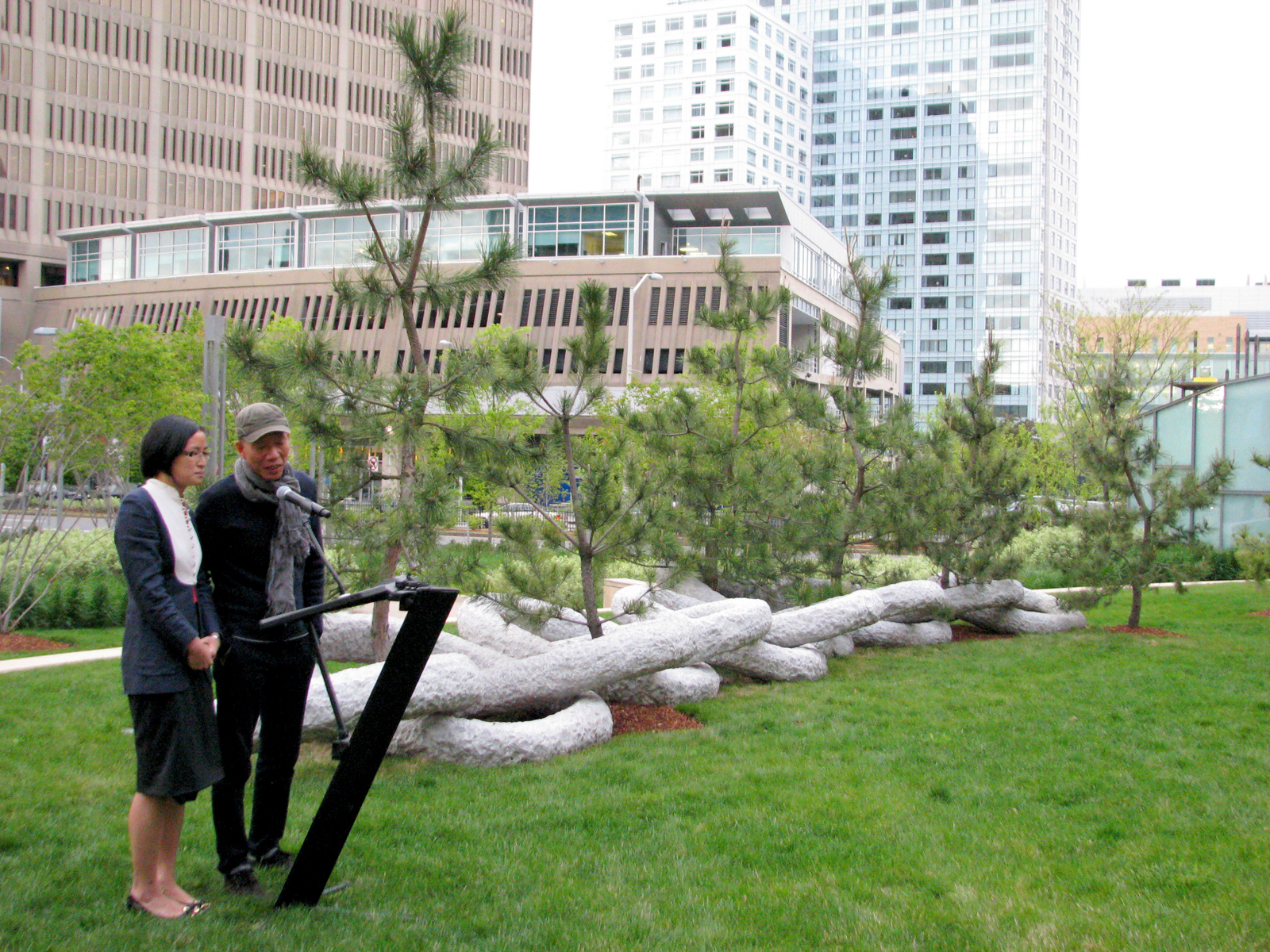
Chinyan Wong(left), Cai Guo-Qiang at the Ring Stone dedication ceremony. (Dan Liu photo)
A public dedication of Ring Stone took place at 6:30PM at the site of the sculpture, with about 100 students, faculty members and friends of MIT attending. Preceding the dedication, the Mr. Cai gave a keynote speech for the MIT China Forum in the MIT Wong Auditorium. Mr. Cai was accompanied by Chinyan Wong, an MIT graduate (class of 2004), who is now project manager at Cai Studio for the past few years in New York City.
| Ring Stone was commissioned for the MIT Sloan School of Management as part of the MIT Percent-for-Art, a program overseen by the MIT List Visual Arts Center. An initiative begun in 1968, the MIT Percent-for-Art allots funds from each new building project or major renovation to commission or purchase art for a public space. In addition to funding by the MIT Sloan School of Management, the work was made possible through generous donations from the Annie Wong Art Foundation and the Robert D. (’64) and Sara-Ann Sanders family. |
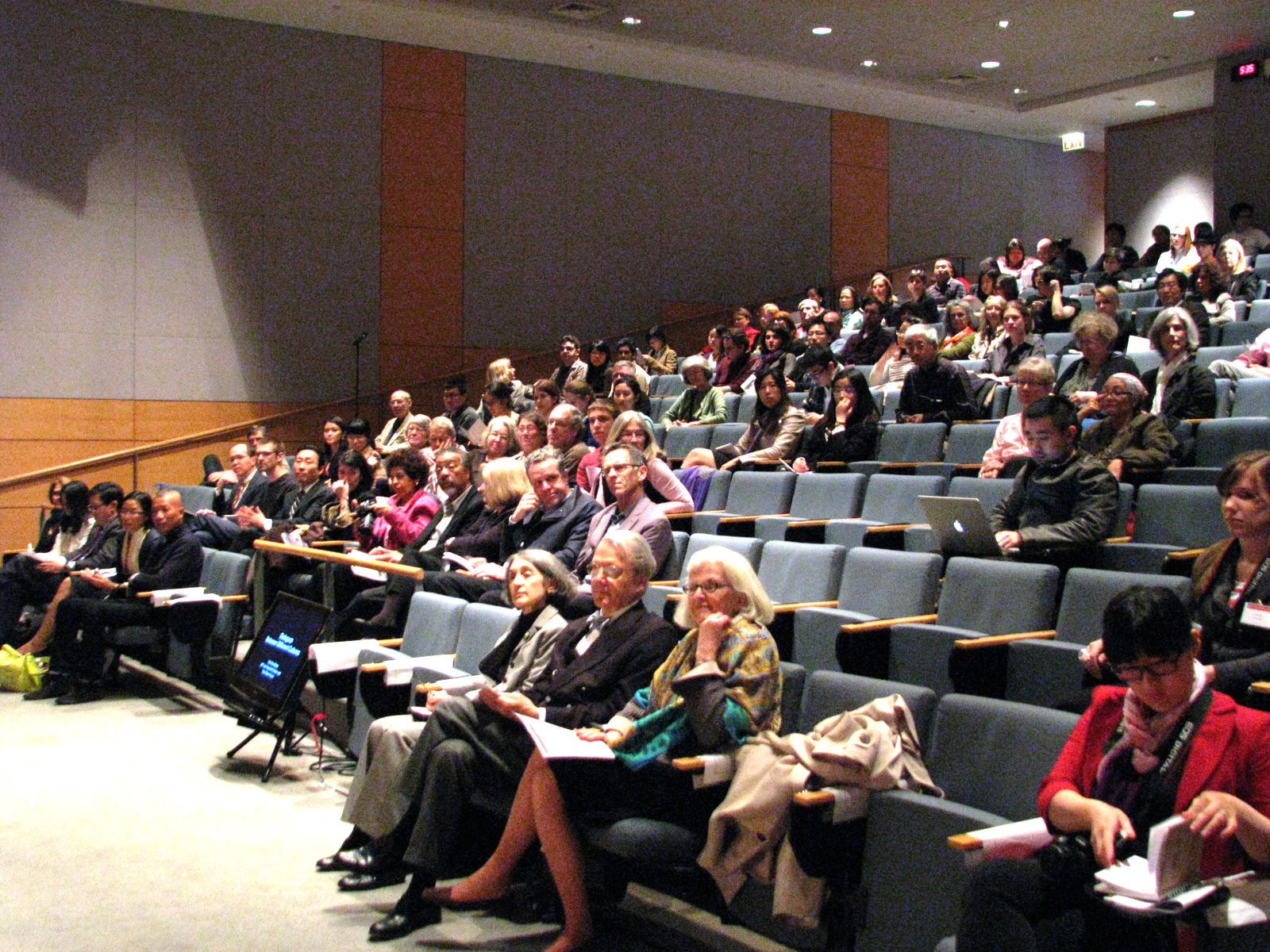 Mr. Cai mentioned in the lecture that the highlight of his career was creating the footprint firework for the opening ceremony of 2008 Beijing Olympic Games. "As an artist, I'm very fortunate to have my creative work used by my country at such an important ceremony," said the artist.
Ring Stone is composed of twelve individual but indivisible links cut from a 39 1/2-foot-long single block of white granite weighing approximately 14 metric tons. The massive stone block was quarried from the caves of Zhangbanzhen, Hui An County, near the artist’s hometown of Quanzhou in southern China’s Fujian Province, which also is where artisan stonemasons carved the work. Seven graceful Japanese Black Pine trees, reminiscent of images found in traditional Chinese landscape painting, are planted inside the rings and nearby.
Mr. Cai mentioned in the lecture that the highlight of his career was creating the footprint firework for the opening ceremony of 2008 Beijing Olympic Games. "As an artist, I'm very fortunate to have my creative work used by my country at such an important ceremony," said the artist.
Ring Stone is composed of twelve individual but indivisible links cut from a 39 1/2-foot-long single block of white granite weighing approximately 14 metric tons. The massive stone block was quarried from the caves of Zhangbanzhen, Hui An County, near the artist’s hometown of Quanzhou in southern China’s Fujian Province, which also is where artisan stonemasons carved the work. Seven graceful Japanese Black Pine trees, reminiscent of images found in traditional Chinese landscape painting, are planted inside the rings and nearby.
| The interlocking, inseparable granite links of Ring Stone form a chain, representing the individual’s relationship to society. The rings are simultaneously symbolic of both wholeness and emptiness. The twelve inextricably linked rings also refer to the twelve months in the Chinese lunar calendar as well as the twelve animals in the Chinese zodiac. The pine trees, which retain their green foliage even in a severe winter, represent longevity and endurance in the face of adversity. While the stone timelessly grounds the work, the seven pines will slowly grow over time and change with each season. |
Comments
One response to “MIT Dedicated Monumental Sculpture by Internationally Renowned Artist Cai Guo-Qiang”
what a materpeace u have going on here