By Jennie Zhang, 11th Grade, Lexington High School
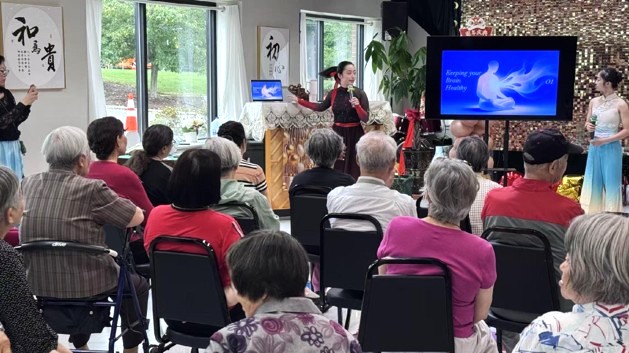
Seventeen-year-old Michelle Liu introduces brain health information to older adults during a Memory in Motion event. The program combines brain health education with simple dance and physical activities. (Photo courtesy of Michelle Liu)
When I was little, my grandmother “made” me learn dance. I didn’t like it. In fact, I resisted it. It was not until after my grandmother had a stroke that I first realized dance could have another meaning.
During her recovery, I tried doing some simple dance and physical movements with her while listening to music. Gradually, we saw her become happier, and her physical condition slowly improved. That experience made me wonder: When dance leaves the stage, what else can it bring to older adults?
So, when I learned that 17-year-old Michelle Liu was running a program called Memory in Motion, I wanted to meet her. Michelle is a senior at Algonquin Regional High School who has studied dance and competed since childhood, winning national and international awards. In November 2024, she founded Memory in Motion, hoping to connect dance, brain health and older adults.
Ahead of World Alzheimer’s Day on Sep 21, 2026, I interviewed Michelle to learn why she decided to bring the dance she knows so well into senior communities.
Becoming Mulan, Not Just Performing Her
Michelle has studied Chinese dance for more than ten years. When she was younger, she also saw dance simply as an activity her parents had signed her up for. As she grew older, she began to understand that dance is both an art and a form of exercise. She learned to express her emotions through movement, rhythm and Chinese folkloric dance.
She especially talked about a recent solo, Mulan. In her understanding of the dance, Mulan moves from calmness in childhood to worry and intensity in war, and finally to freedom. The story of Mulan revolves around discovering identity. Playing the role encouraged Michelle, a young Chinese American, to think again about her own cultural identity.
“I learned to see dance as an extension of myself,” she said. “To actually become Mulan, rather than just perform her.” Dance as an expression of emotions and personal stories became a stronger concept in Michelle’s mind.
For years, Michelle has also performed folkloric dance at senior centers through the Angel Dance Youth League of Angel Dance Company. She noticed that older adults did not just enjoy watching. They also liked participating and interacting with the dancers. Those early performances and volunteer experiences at senior centers helped inspire her decision to bring dance into senior communities.
From the Stage to the Lab: Studying the Brain and Memory
Michelle once thought she would study biology or chemistry in the future, and she had always been looking for a connection between dance and science. Since May 2025, under the guidance of a college professor, she has been conducting research related to Alzheimer’s disease and related dementias (ADRD) and mild cognitive impairment (MCI). She is currently preparing to submit a related research paper.
Her research has made her more aware of the barriers to early diagnosis of ADRD. It has also led her to think more seriously about the relationships being studied among physical activity, healthy aging and brain health, a lot being evidenced by scientific literature. She said she finally began to see the connection between dance and science that she had been searching for.
Michelle wanted to bring some of the more difficult ideas from research into the communities where older adults live their daily lives. Participants do not have to understand professional research papers first. Through her brain health presentations, she encouraged them to talk about the brain and aging in a familiar and relaxed setting as well as in a layman language that is easier for older adults to understand.
Their Response Gave Her a Reason to Keep Going
Michelle had performed in front of hundreds of older adults before, yet the first time she actually stood in front of a group of seniors to teach dance, she was still nervous. During performances, the audience only needed to watch. This time, she needed everyone to participate. She worried that the movements might be too difficult, or that older adults who had never experienced Chinese dance might not like it.
Before the event, she prepared a special warm-up playlist featuring ABBA, Billy Joel and Queen. Once the familiar music began, the feeling of unfamiliarity slowly disappeared. Everyone moved to the music and talked with one another during the warm-up stretches before moving on to the Chinese dance movements and breathing exercises.
It went better than she had expected. After the class ended, the participants were still talking excitedly, and some said they would tell their friends about the program. What began as a one-time experiment later became a regular activity.
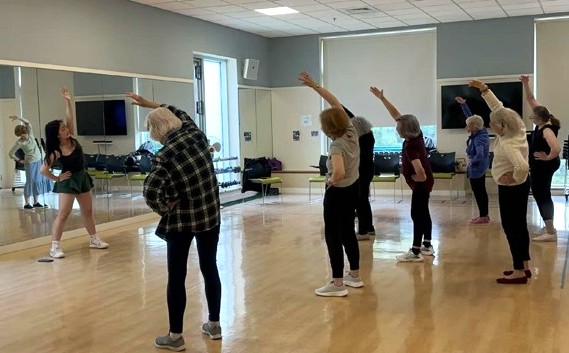
Michelle Liu leads older participants through simple stretching and physical activities. The class emphasizes participation and does not require previous dance experience or professional equipment. (Photo courtesy of Michelle Liu)
Protecting Brain Health by Bringing Prevention Awareness Into Daily Life
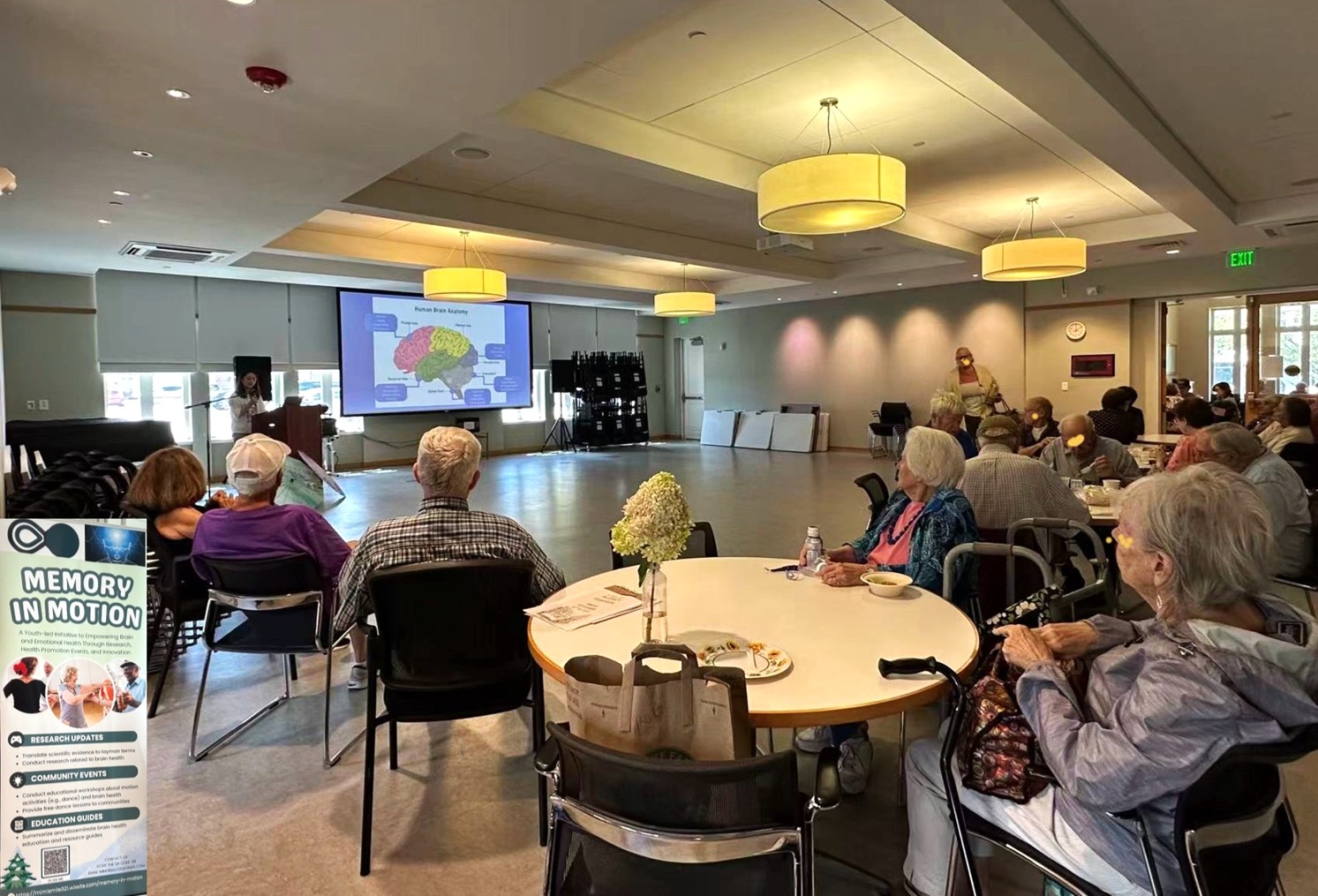
Memory in Motion is not a performance brought to senior centers simply for entertainment, nor is it professional dance training. The program usually begins with a short presentation introducing the brain, healthy aging, and research related to physical activity and brain health in an easy-to-understand way. Participants then take part in a lesson where Michelle and her team teach simple Chinese dance and physical activities.
Michelle is careful to explain that the program does not promote dance as a treatment for Alzheimer’s disease. Instead, it encourages people to make physical activity appropriate for their own condition, social engagement and brain health knowledge part of everyday healthy aging.
The program has run sessions at senior centers, retirement communities and adult day health centers across Massachusetts, some of them bilingual. According to post-event surveys provided by Memory in Motion — not clinical research results — 96% of participants said they were satisfied, 97% said they felt happier after the activity, and 96% said they would like to continue participating in physical activities that benefit brain health.
After one event, a staff member at the senior center sent an email that said, “THEY LOVED YOU!!! WOW!” Michelle remembers feeling extremely relieved when she saw the email. There had been some problems with scheduling and communication before the event, and she had stressed about whether everything would go smoothly. The email, she said, was the first time she felt directly that what she was doing had truly brought something to other people.
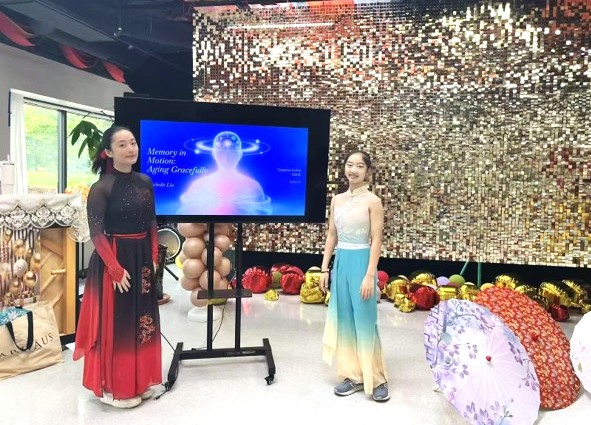
Michelle Liu (left) and a team member at a Memory in Motion event. The program currently holds most of its in-person activities in Massachusetts. (Photo courtesy of Michelle Liu)
What She Wants to Tell Her Peers Before September 21
I asked Michelle what older adults had taught her through this project. Many people know brain health matters, she said, but few build it into daily life. She’s also learned that age doesn’t have to divide people — a familiar song and a few simple movements can help a teenager and someone decades older find a common language.
On Alzheimer’s specifically, what she most wants young people to notice is the stigma surrounding aging and dementia. In her view, stigma can make people afraid to talk about the disease and can also become a barrier to seeking diagnosis and help. Instead of putting labels on older adults, she believes communities should offer more understanding and support.
For this year’s World Alzheimer’s Day, Michelle is holding a local event in Southborough. She also hopes people her age will occasionally step away from their screens to spend some time learning about Alzheimer’s disease, healthy aging, and the people around them who are growing older. She said that the inter-generational interactions makes her program really unique and fun for older adults. Massachusetts House of Representatives unanimously passed House Bill H.5621 (the Alzheimer’s Act of 2026) on July 29, 2026. Michelle said she was very proud of working on this project that is aligned with the public attention toward combating ADRD.
Even If It Changes Just One Person’s Life
Memory in Motion has reshaped the way Michelle thinks about her own future. She now hopes to study cognitive science in college and continue using research and learning opportunities to improve the program. Its in-person activities are currently based mainly in Massachusetts, while team members in different parts of the United States participate online.
She hopes that five years from now, Memory in Motion would become a program that could grow beyond Massachusetts and reach more communities.
“My dream is for my work to make a positive difference in someone’s life—even if it is just one person.”
Author’s Reflection:
While interviewing Michelle, I often thought about my own grandmother. After her stroke, I simply hoped that music and dance could help her move a little and feel a little happier. I did not see that experience as a project, nor did I study it from a scientific perspective. But it showed me for the first time that when a young person reaches out to an older person, what we give each other is more than companionship. Something inside us changes, too.
We are both still high school students, and growing old may seem very far away. But we do not have to wait until we are old ourselves before we begin to care about aging. For Michelle, it began with dance. For me, perhaps it began the moment my grandmother took my hand and started moving with me to the music.
Leave a Reply