By David Li, bostonese.com
Boston, Sept. 30, 2013, — Doing research in life sciences is a tough business. It requires years of training, long work hours and patience. Breakthrough discoveries are few and far in between, but they could improve lives of millions people. Recently, a symposium at Harvard Medical School (HMS) drew about 300 students and researchers to packed Cannon Room of Building C to listen to four distinguished fellow researchers sharing their experiences.
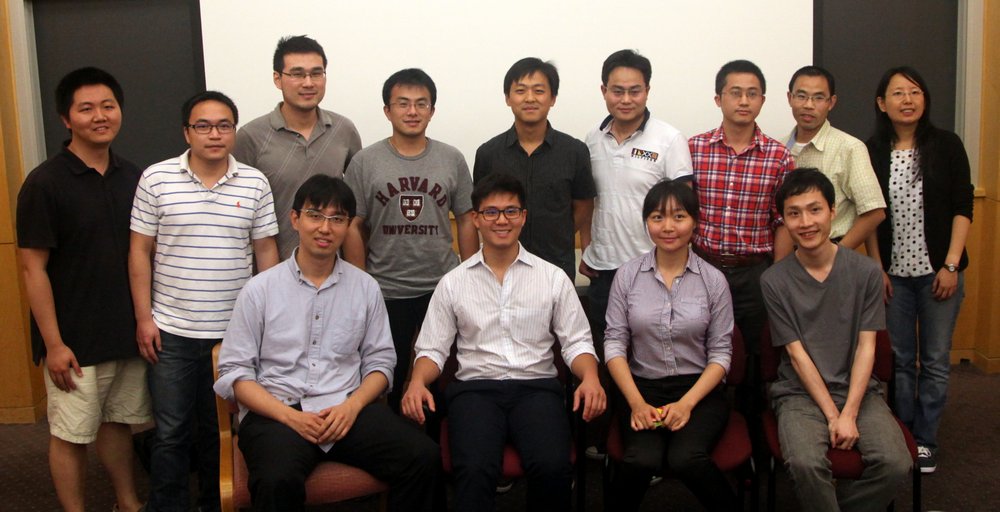
Speakers and organizers of the symposium take a group picture (photo by David Li).
|
|
According to wikipedia, CRISPRs (Clustered Regularly Interspaced Short Palindromic Repeats) are loci containing multiple short direct repeats that are found in the genomes of approximately 40% of sequenced bacteria and 90% of sequenced archaea. CRISPR functions as a prokaryotic immune system, in that it confers resistance to exogenous genetic elements such as plasmids and phages. The application of CRISPRs is that it could significantly shorten the time it required for studying gene mutation, and thus accelerate research. Chaoshe Guo, a postdoctoral researcher at HMS mentioned that he was curious to know the latest advances in this field, and marked this event in his calendar a few weeks in advance. |

| Wei Song, president of Harvard Medical School Chinese Scholars and Scientists Association (HMS-CSSA), pointed out that the four speakers were among the best in CRISPR research, and people were really excited to listen to their talks and learn from their experiences with the emerging research technique. After the talks, the four speakers had panel discussions with the participants, and answered questions. The symposium was organized by HMS-CSSA (www.hms-cssa.org) and HMS/HSDM Postdoctoral Association (www.hms.harvard.edu/pda), and sponsored by Charles River and Life Technologies. |